

Meeting Held in Pirpainti Over Adani Plant, Farmers and Local Workers Demand Jobs and Compensation; Protest Warning if Demands Are Not Met
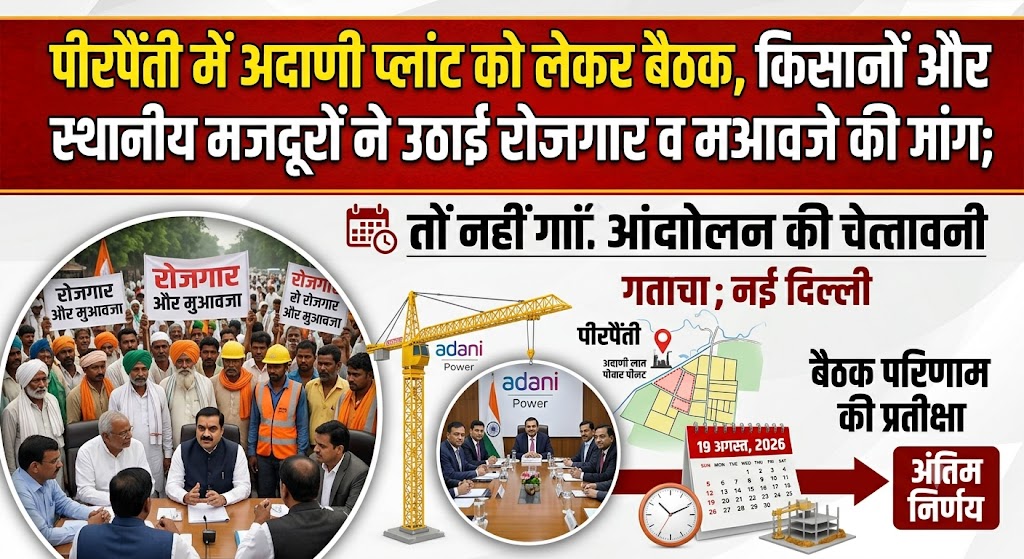
Bhagalpur: A meeting was held in Pirpainti regarding issues related to the proposed Adani plant. The meeting was attended by the contractor associated with the plant, along with local farmers and workers. During the meeting, farmers and local labourers raised demands related to employment and compensation.
Local residents said that expectations have increased with the proposed industrial project in the area. They want people living in and around the project area to receive employment opportunities and proper compensation if their land or livelihood is affected.
The participants warned that if their demands are not considered seriously, they may resort to democratic protests. However, the final outcome will depend on further discussions between the concerned parties and the administrative process.
Employment Becomes a Major Issue
Local workers prominently raised the issue of employment during the meeting.
They said that if a major industrial plant is established in the area, local youth and workers should receive priority for available jobs.
Residents argued that the benefits of a large industrial project should not remain limited to outside agencies or companies. Employment opportunities in construction, transportation, security, technical assistance and other activities could help strengthen the local economy.
Workers said that a large number of people in the area are looking for employment. If they receive work through the project, they will be able to earn a livelihood without having to leave their home region.
Farmers Raise Compensation Concerns
Farmers also raised the issue of compensation.
Those whose land could be affected by the project are demanding fair and transparent compensation.
Farmers said that land is not simply a piece of property but an important source of livelihood. Many families depend on agricultural income for their financial security.
Therefore, if land is acquired or affected for an industrial project, the interests of the affected families should be protected and proper compensation and other applicable benefits should be ensured.
Farmers also demanded a transparent compensation process so that affected families do not have to repeatedly visit government offices to resolve their concerns.
Demand for Local Participation
The meeting also highlighted the importance of local participation in the project.
Farmers and workers want their concerns and requirements to be considered while decisions related to the project are being taken.
They believe that development will truly benefit the region only when local residents receive direct or indirect benefits from the project.
Employment and compensation are among the most important aspects of this demand.
Discussion With the Contractor
Local residents presented their concerns in the presence of the contractor associated with the plant.
Farmers and workers explained their position on employment and compensation-related issues.
The meeting provided an opportunity for both sides to discuss the issues and explore the possibility of finding a solution through dialogue.
Residents now expect their demands to be communicated to the concerned authorities and project officials.
Employment Opportunities for Local Youth
The industrial project could potentially create new employment opportunities for young people in Pirpainti.
Large industrial plants require workers during construction as well as during subsequent operations. Employment opportunities can also arise in transportation, security, maintenance, food services, logistics and other support activities.
Local youth are therefore demanding priority in such opportunities.
If local people receive employment within the project, migration to other cities and states in search of work could potentially be reduced.
Land Is Crucial for Farmers
For farmers, the issue of land is particularly sensitive.
Their families and future livelihoods are closely connected to agricultural land.
Farmers argue that if land is affected by the project, immediate compensation alone may not be sufficient. The long-term livelihood of affected families should also be considered.
They want the compensation process to be transparent and for the value and impact of the affected land to be properly assessed.
Protest Warning if Demands Are Not Met
Local residents warned that they may launch protests if their demands are not addressed appropriately.
They said they would raise their concerns through democratic and peaceful means.
The objective, according to the local residents, is not necessarily to oppose development but to ensure that the rights and interests of local farmers and workers are protected.
The exact form and timing of any future protest will depend on further discussions and the response from the administration and project authorities.
Role of Administration Is Important
The administration is likely to have an important role in resolving the issues.
Large industrial projects require coordination between farmers, local residents, workers, project agencies and government authorities.
If differences arise, dialogue can be an effective way to resolve them.
The administration can listen to the complaints of farmers and workers and hold discussions with the concerned parties. Such efforts could help prevent disputes from escalating.
Local Interests Must Accompany Industrial Development
A major industrial project can create expectations of economic development in the region.
The establishment of a plant can potentially generate employment, investment and improvements in infrastructure and services.
However, local residents want the benefits of development to reach them as well.
If farmers and workers living around the project receive employment and other economic opportunities, the local economy could receive a significant boost.
Maintaining a balance between industrial development and local interests will therefore be important.
Local Markets Could Also Benefit
The arrival of a large industrial plant can influence nearby markets.
An increase in the number of workers and employees can create additional demand for local shops, transport services, restaurants and other small businesses.
This could provide opportunities for local traders and service providers.
However, residents want local people to participate in these economic activities rather than seeing most opportunities go to outsiders.
Skill Training Could Improve Employment Prospects
Providing skill training to local youth could also be important for employment.
If young people are trained for technical and non-technical positions associated with the project, they could become better prepared for long-term employment.
Skill development could benefit both the project and the local population by creating a pool of trained workers in the surrounding area.
Demand for Transparency in Compensation
Farmers placed particular emphasis on transparency in compensation-related matters.
In any land-related process, details regarding documentation, land status, compensation calculations and payment procedures need to be clearly communicated.
Farmers said they should receive complete information to prevent disputes at a later stage.
A transparent process can help build trust between affected residents and project authorities.
Hope for a Solution Through Dialogue
Following the meeting, local residents expressed hope that the concerned parties would take their demands seriously.
If positive discussions are held on employment and compensation at an early stage, the possibility of a dispute could be reduced.
There remains an opportunity to communicate the concerns of farmers and workers to the relevant authorities and seek a solution through further meetings.
Balancing Development and People's Rights
The issue surrounding the proposed Adani plant in Pirpainti highlights the importance of balancing industrial development with the rights and interests of local residents.
On one hand, large projects can create opportunities for investment, employment and infrastructure development.
On the other hand, if local people's land or livelihoods are affected, their concerns must also be addressed fairly.
Dialogue, transparency and coordination among all stakeholders will therefore be essential.
Attention on Further Discussions
Local farmers and workers are now waiting for the next round of discussions and administrative action.
They hope that clear solutions will be found regarding employment and compensation.
If an agreement is reached, it could help create a more positive environment around the project.
If the concerns remain unresolved, however, local residents have indicated that they may proceed with protests.
The meeting in Pirpainti regarding the Adani plant brought employment and compensation issues to the forefront, with local farmers and workers demanding that their interests be protected.
Local residents want young people and workers from the area to receive priority for employment opportunities connected with the project. Farmers are also demanding fair and transparent compensation if their land is affected.
The participants said that industrial development could create new opportunities for the region, but the benefits should also reach the local population.
They warned that if their demands are not properly considered, they may resort to democratic protests.
The next steps by the project authorities, contractor and administration will therefore be important. Whether the matter is resolved through dialogue or develops into a larger protest will depend on the response to the demands raised by the local farmers and workers.