

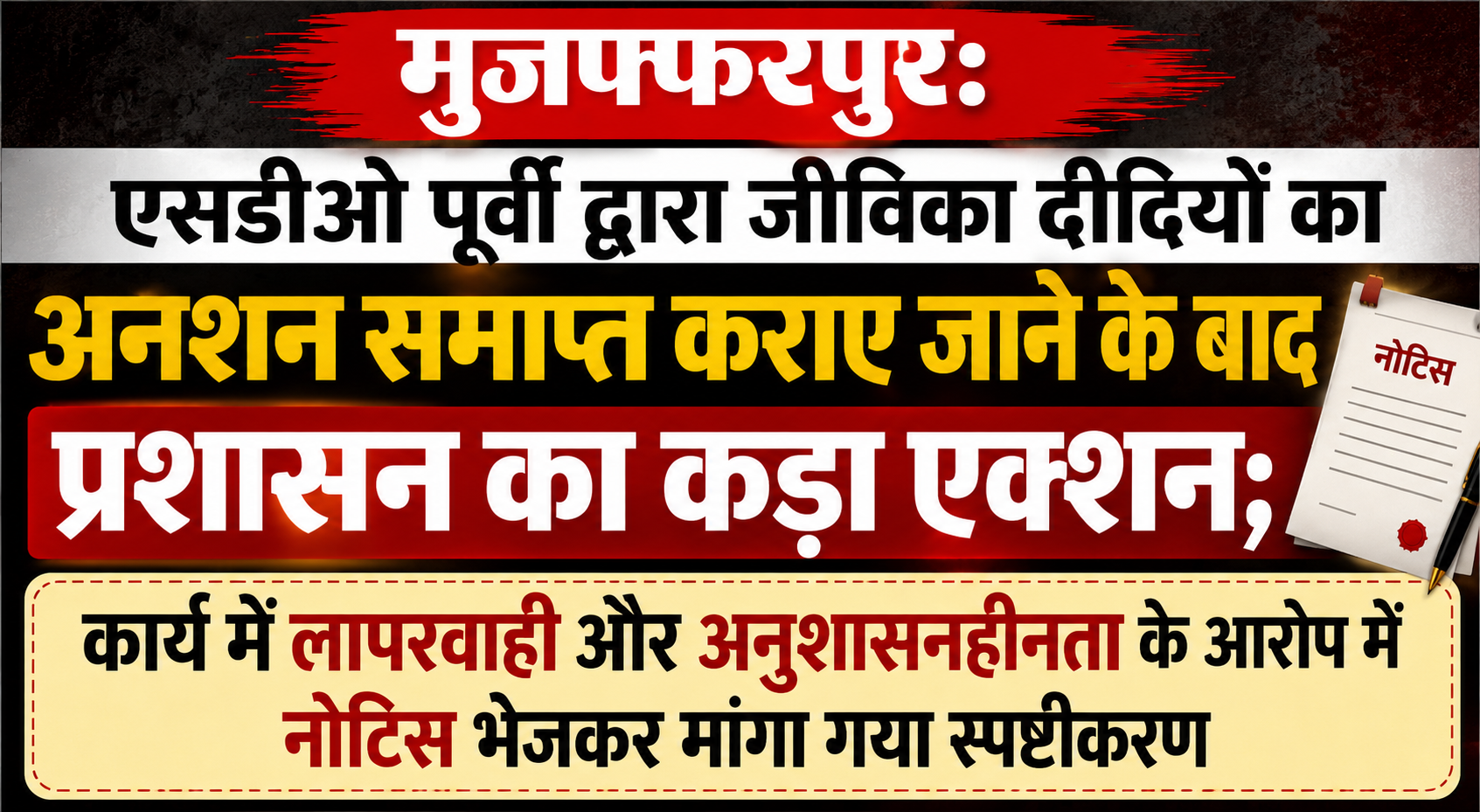
Muzaffarpur: Strict Administrative Action Follows SDO East's Intervention in Ending Jeevika Didis' Fast; Show-Cause Notices Issued for Alleged Negligence and Indiscipline, Stirring Panic in Administrative Circles
Muzaffarpur (Bihar): An extremely significant and sensational news story has emerged from the administrative corridors of Muzaffarpur district. Shortly after the Sub-Divisional Officer (SDO) East of Muzaffarpur successfully ended the hunger strike of Jeevika Didis (community workers) who were protesting for their demands by offering them juice, the administration has adopted a strict punitive stance. Right after the fast concluded, the district administration officially issued show-cause notices to selected Jeevika Didis and related contractual personnel who participated in the agitation and protests. These notices demand explanations for allegedly obstructing administrative functioning, violating superiors' directives, and displaying indiscipline. Following this swift administrative step, panic has rippled through Jeevika cadres and women associated with self-help groups, while departmental officials maintain that tightening the screws on those acting outside regulatory frameworks to disrupt public systems was imperative.
Let us understand a detailed, analytical, and point-by-point description of this deadlock between the rural livelihood mission and governance, the background of ending the hunger strike, the legal and administrative dimensions of the issued notices, and their potential outcomes.
Background of the Incident: Jeevika Didis' Hunger Strike and SDO East's Intervention
Jvika Didis had been staging continuous protests in Muzaffarpur over various demands, which eventually escalated into an indefinite hunger strike or sit-in demonstration.
Strike and Hunger Strike Scenario: Pressing for increased honorarium, improved service conditions, and other administrative demands, Jeevika Didis had opened a front in front of the Eastern Sub-Divisional Office and sat on a hunger strike.
Deteriorating Health and Administrative Sensitivity: During the hunger strike, the health of some women began to deteriorate, intensifying anxiety within the administrative machinery. Sensing the gravity of the situation, SDO East took personal initiative.
Ending the Fast with Juice: SDO East reached the spot, engaged in dialogue with the protesting women, assured them of sympathetic consideration toward their legitimate demands, and ended their fast by offering juice. At the time, this was hailed as a major diplomatic and sensitive success for the administration.
Administrative Whip Launched Right After Fast Concluded: Notices Issued
Just days after the hunger strike ended, the administration exhibited a stern attitude by initiating disciplinary proceedings through the issuance of formal notices.
Recipients of the Notice: Prominent Jeevika Didis who spearheaded the agitation, Community Coordinators (CCs), and certain contractual workers were identified and served administrative notices.
Allegations Cited in the Notices: The notices primarily state that boycotting official duties, staging unauthorized sit-ins within office premises, and flouting instructions from senior officers violate service rules and contractual terms.
Demand for Clarification: The administration has instructed all concerned parties to clarify within a stipulated timeframe (such as 48 to 72 hours) why disciplinary and contract-termination actions should not be initiated against them.
Administrative Rationale Versus Jeevika Didis' Reaction
Following the issuance of these notices, a sharp debate has broken out between the administrative justification and the stand taken by the protesting women.
The Administration's Perspective: The district administration believes that while expressing grievances through dialogue and democratic means is a right, disrupting official work, throwing caution to the wind regarding office property or discipline, and challenging administrative systems cannot be tolerated.
Outrage Among Jeevika Didis: On the other hand, the Jeevika Didis expressed deep resentment upon receiving the notices. They argue that the administration first had their fast broken through dialogue and is now mentally harassing them by sending retaliatory notices.
Uncertainty Over Demands: The women accuse authorities of failing to issue any concrete written agreement or order concerning their demands, while the administration resorts to notices as an intimidation tactic.
Departmental and Political Ripples
This entire sequence of events has intensified political whispers and internal rumblings within the Rural Development Department in the district.
Support from Employee Unions: Several other contractual employee unions and labor organizations have condemned the notices served to the Jeevika Didis, labeling the move as dictatorial. They warned that if the notices are not withdrawn, they may launch a broader agitation anew.
Monitoring by Higher Authorities: The Commissioner's and District Magistrate's offices are closely monitoring the situation to ensure that law and order as well as the execution of development schemes remain unaffected.
The administration's action of issuing notices and demanding explanations from Jeevika Didis following SDO East's intervention to end their hunger strike in Muzaffarpur highlights a dual approach in administrative governance. On one hand, the administration exhibited sensitivity by terminating the hunger strike, while on the other, it began tightening legal screws under the pretext of maintaining discipline. This scenario indicates that ensuring transparency and discipline in administrative work is just as vital as resolving employee grievances in a time-bound and humane manner. In the coming days, it will be interesting to observe what stance the administration adopts following the Jeevika Didis' responses and how this dispute reaches a permanent resolution.