

Patna High Court Cancels Expulsion of Class 9 Student from Don Bosco Academy, Orders Reinstatement
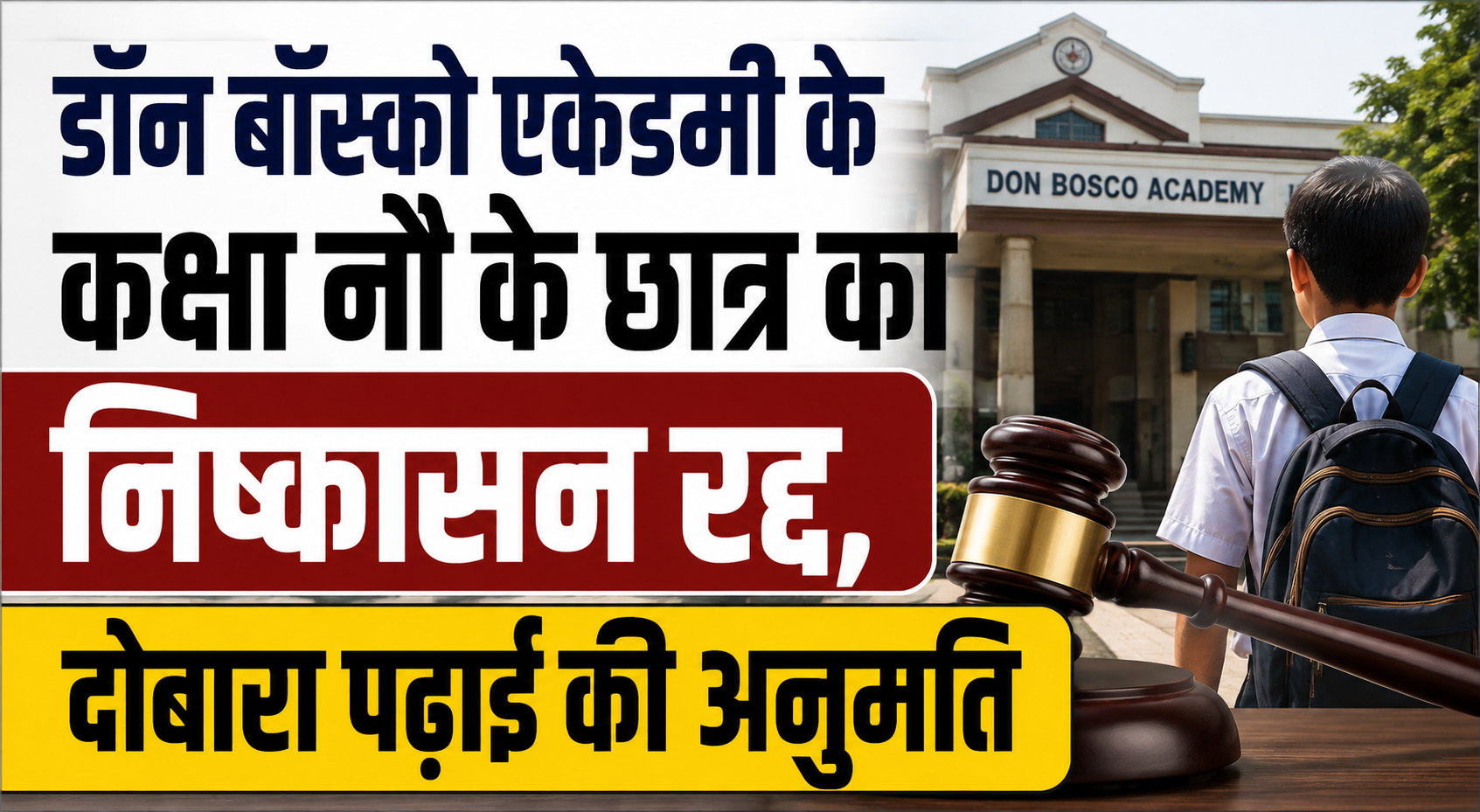
Patna: The Patna High Court has provided relief to a Class 9 student of Don Bosco Academy by cancelling his expulsion from the school over alleged indiscipline. A single-judge bench headed by Justice Harish Kumar set aside the expulsion order dated October 17, 2025, and directed the school management to allow the student to return to the classroom and participate in academic activities.
The High Court observed that discipline is essential in schools, but disciplinary action against minor students must be consistent with the rules, principles of natural justice and proportionality. The court also emphasized that corrective measures should be considered before imposing the harshest punishment of expulsion.
Student Expelled Over Alleged Indiscipline
According to the case, the Class 9 student of Don Bosco Academy was accused of several acts of indiscipline.
The school claimed that the student frequently skipped classes, failed to follow teachers' instructions and was also involved in an incident involving a physical altercation with another student.
According to the school management, the student had been warned several times and was also provided counselling. However, the school claimed that his behaviour did not improve despite these efforts.
The management subsequently took disciplinary action and expelled the student. The expulsion order was issued on October 17, 2025.
School Relied on Its Rules
Before the court, the school argued that its rules permitted expulsion in cases of serious misconduct.
The management maintained that the student's conduct went beyond ordinary indiscipline. Repeatedly missing classes, disobeying teachers and allegedly becoming involved in a physical altercation were cited as reasons for the disciplinary action.
The school also stated that it had attempted to correct the student's behaviour through warnings and counselling before taking the final step.
High Court Recognizes Need for Discipline
The High Court did not hold that schools lack the authority to take disciplinary action.
The court acknowledged that principals and school authorities have the power to maintain discipline and take appropriate action when students repeatedly violate school rules.
However, the court made it clear that such powers must be exercised according to established procedures. This is particularly important when the matter concerns a minor student.
Authorities must consider the student's age, circumstances, nature of the misconduct and the consequences of the proposed punishment.
Expulsion Is the Harshest Punishment
The High Court treated expulsion as one of the most severe forms of disciplinary punishment.
Removing a student from school can have a direct impact on his education and future. Therefore, before imposing such a severe penalty, authorities should consider whether less severe measures could effectively address the student's behaviour.
The court emphasized the principle of proportionality, which requires the punishment to correspond reasonably to the seriousness of the misconduct.
A relatively minor disciplinary violation should not automatically result in the harshest possible punishment.
Skipping Classes Alone Not Sufficient
One important issue before the court was whether repeatedly skipping classes could itself justify expulsion.
The High Court noted that merely skipping classes was not clearly specified in the school's rules as an offence warranting expulsion.
Absence from classes may constitute indiscipline, but it cannot automatically be treated as grounds for the most severe disciplinary action unless the applicable rules specifically provide for such a consequence or the surrounding circumstances make the conduct sufficiently serious.
The observation is significant for schools because disciplinary action should remain within the framework of their written rules.
Altercation Must Be Examined in Context
The school had also alleged that the student was involved in a physical altercation with another student.
The court indicated that such an incident should also be assessed in its proper context.
Authorities should examine the seriousness of the incident, the student's actual role, the circumstances leading to the altercation and the nature of the conduct before deciding on a punishment.
Not every dispute or altercation should automatically be treated as grounds for the most severe disciplinary penalty.
Natural Justice Must Be Followed
The principle of natural justice was also important in the High Court's consideration of the case.
Before imposing serious disciplinary action, a student should have a fair opportunity to present his side of the matter.
This becomes particularly important when the student is a minor. The school should take into account the student's age, level of understanding, possibility of behavioural improvement and circumstances surrounding the alleged misconduct.
Maintaining discipline and ensuring a fair process must go hand in hand.
Court Emphasizes Corrective Measures
The High Court stressed the importance of corrective measures in dealing with students.
According to the approach reflected in the ruling, the objective of school discipline should not simply be to punish a student for violating rules. It should also be to help the student understand the consequences of his behaviour and return to a disciplined academic environment.
Counselling, parental involvement, behavioural guidance, warnings and closer supervision can sometimes help students improve their conduct.
This approach can be particularly important during adolescence, when students are still developing emotionally and socially.
Student Ordered to Return to Class
The High Court cancelled the expulsion order and directed the school to allow the student to return to the classroom.
The student must also be permitted to participate in academic activities.
The order provides an opportunity for the student to resume his education. Prolonged exclusion from school could otherwise have disrupted his studies and potentially affected his academic year.
Important Message for Schools
The Patna High Court's decision has implications beyond this particular case.
Schools have the authority to maintain discipline, but disciplinary action should take into account the institution's written rules, the seriousness of the alleged misconduct, the student's age, the circumstances of the incident and the possibility of correction.
The harshest punishment should be imposed only when it is justified by the circumstances and permitted under the applicable rules.
Balancing Education and Discipline
Discipline and education are closely connected. A school cannot function effectively without reasonable discipline. However, the purpose of discipline should ultimately be to support education rather than unnecessarily remove students from it.
The ruling highlights the importance of combining disciplinary measures with a corrective and educational approach.
When dealing with minors, schools should exercise particular care because severe disciplinary action can have long-term consequences for a student's educational and social development.
Relief for the Student and Family
The student's expulsion would likely have created significant concerns for his family regarding his education and future.
The High Court's decision gives the student an opportunity to continue his studies at the institution.
The ruling also reinforces the principle that disciplinary proceedings involving minor students must remain within the boundaries of fairness, established rules and legal principles.
Conclusion
The Patna High Court's decision to cancel the expulsion of the Class 9 student of Don Bosco Academy highlights the need to maintain a balance between school discipline and the educational rights of minor students.
The court recognized the school's authority to take disciplinary action but emphasized that expulsion, as a severe punishment, must comply with the school's rules, natural justice and the principle of proportionality.
Skipping classes alone cannot automatically justify expulsion, while an alleged physical altercation must also be assessed according to its nature, seriousness and circumstances.
With the expulsion order cancelled, the student will be allowed to return to class and participate in academic activities. The ruling sends a broader message that in cases involving minors, correction and rehabilitation should be considered alongside punishment, while ensuring that the student's education is not unnecessarily disrupted.