

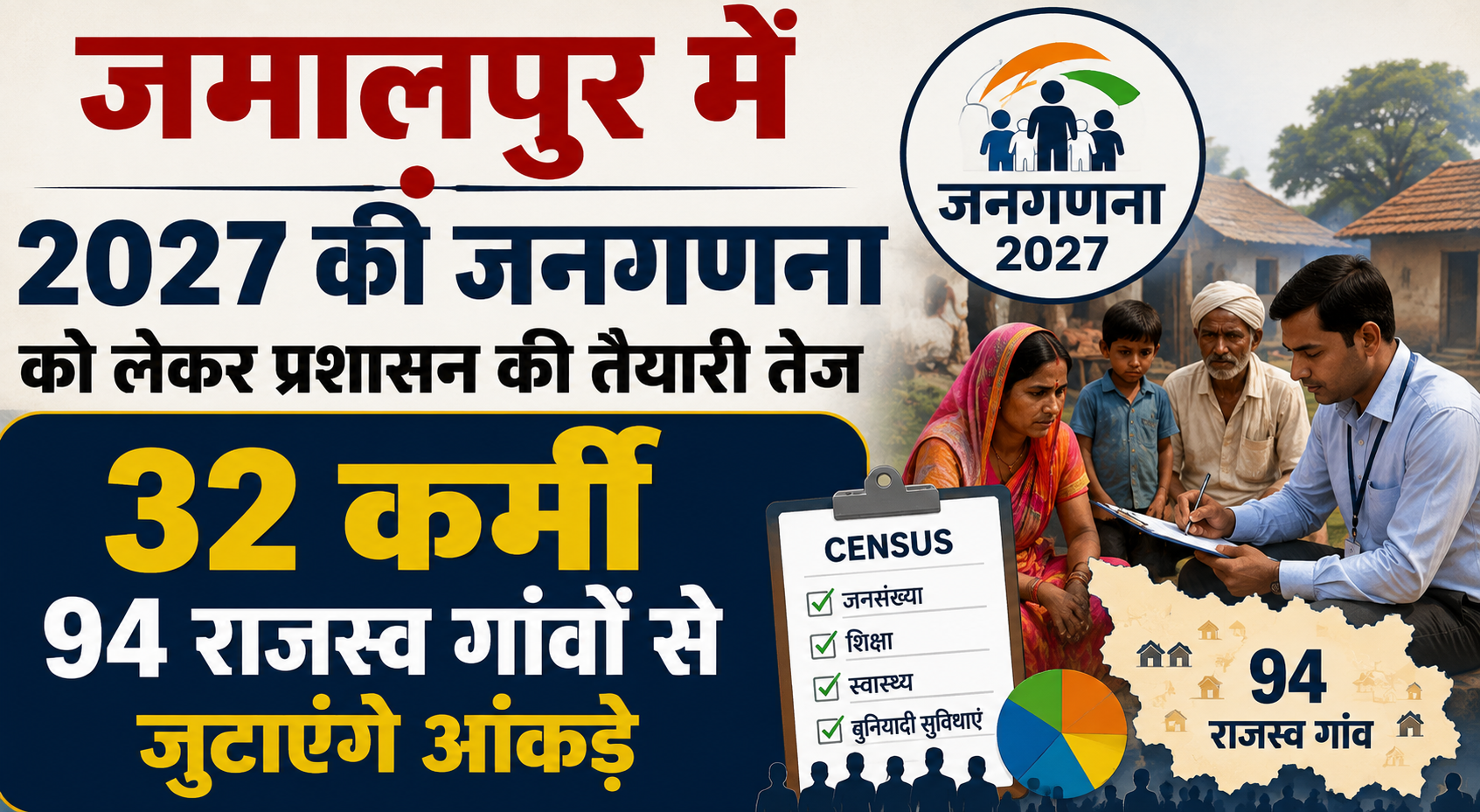
Preparations for 2027 Census Intensify, 32 Personnel to Collect Data From 94 Revenue Villages
Jamalpur, Munger: Administrative preparations for the 2027 Census have gained momentum in Jamalpur. A meeting was organized at the Jamalpur Sadar Block Office to discuss the census-related preparations, data collection process and responsibilities assigned to officials and field personnel. The meeting was chaired by Block Development Officer (BDO) Shweta Kumari.
A total of 32 personnel have been assigned responsibility for collecting various types of information from 94 revenue villages falling under the Jamalpur Sadar block area. The personnel will be assigned specific areas and will collect the required information from villages and households as part of the census-related exercise.
The data collection process will not be limited to basic population information. It will also include information related to education, healthcare and basic infrastructure available in rural areas. The collected data will help provide a clearer picture of the social and economic conditions of the region.
Data to Be Collected From 94 Revenue Villages
The 94 revenue villages under the Jamalpur Sadar block have been included in the data collection exercise. The administration has assigned 32 personnel to carry out the work.
The personnel will visit their designated areas and collect the required information. They have been instructed to follow the prescribed guidelines carefully so that there are no errors in the data.
Officials discussed during the meeting that census data plays an important role in planning future government schemes and development programs. Therefore, it is essential that information related to each village and household is recorded accurately.
Education-Related Information to Be Collected
Education will be an important component of the data collection exercise. Information related to the availability of educational facilities, the condition of schools and the educational status of residents may be collected.
Such information will help authorities understand the actual condition of education in rural areas.
The data can later be useful in planning the development of schools, additional classrooms, teacher requirements and other educational resources.
Healthcare Facilities Also Under Focus
Information regarding healthcare facilities will also be collected as part of the census-related exercise.
Details about the availability of health centers and access to healthcare services in rural areas can help authorities identify areas where additional medical facilities may be required.
Access to primary healthcare is particularly important for rural communities. Accurate data can help in planning health centers, medical services and other necessary resources.
Focus on Basic Infrastructure
The data collection process will also focus on basic infrastructure available in villages.
Information related to roads, drinking water, electricity, housing and other essential facilities is important for assessing the living conditions of rural households.
Accurate information about which villages have access to specific facilities and which areas continue to face shortages can help authorities plan development programs more effectively.
Responsibilities Assigned to 32 Personnel
The responsibilities of the 32 personnel were also discussed during the meeting.
Each official or field worker will be responsible for collecting data from the area assigned to them.
Officials have been instructed to ensure that all required information from their designated areas is recorded according to the prescribed procedure.
Accuracy is one of the most important aspects of census-related work. Even a small error can affect the reliability of the final data. Therefore, personnel will need to perform their duties carefully.
Information to Be Collected at the Village Level
The data collection exercise will not remain limited to the block office. Personnel will visit villages and households to collect the required information.
The 94 revenue villages have been divided among personnel according to different areas. This division of responsibility is expected to help complete the work in an organized manner.
The administration will seek to collect information directly from local residents so that the final data reflects ground realities.
Importance of Census Data
A census is not simply a process of counting the population. It also helps provide an understanding of the social, economic and infrastructural conditions of a region.
Information about population distribution, education, healthcare, basic infrastructure and other social indicators can help authorities understand local conditions.
Governments and administrative agencies can use such data to determine priorities for various welfare and development programs.
Data Will Help in Development Planning
The information collected from the 94 revenue villages of Jamalpur Sadar block could be useful for future development planning.
If the data shows a shortage of educational facilities in a particular area, authorities can consider strengthening educational infrastructure there.
Similarly, areas with inadequate healthcare facilities can be identified for possible improvements.
Data regarding basic infrastructure can also help determine which areas require greater attention in terms of roads, drinking water, electricity and other public facilities.
Special Attention to Data Quality
Collecting a large amount of information is not enough. The quality and reliability of the data are equally important.
Personnel will need to follow the prescribed formats and guidelines while recording information.
The collected data may also need to be checked to identify incomplete or incorrect information so that necessary corrections can be made in time.
Administrative supervision can help ensure that the data collection process remains systematic and reliable.
Administrative Monitoring
The meeting chaired by BDO Shweta Kumari focused on the overall process of data collection and the responsibilities of the personnel.
The administration aims to ensure that all required information from the designated villages is collected accurately and within the prescribed schedule.
With 32 personnel assigned to cover 94 revenue villages, the work has been divided into different areas to facilitate systematic data collection.
Ground Reality of Rural Areas to Be Highlighted
The census-related data is expected to provide a clearer picture of the actual conditions in the rural areas of Jamalpur Sadar.
Information regarding education, healthcare and basic infrastructure can help identify the current level of development and areas where additional efforts may be required.
Local-level data can give administrators a better understanding of the actual needs of rural communities.
Preparation for Timely Completion of Work
The data collection exercise is expected to be carried out according to a prescribed schedule.
After assigning responsibilities to the personnel, the administration is preparing to begin the field-level work.
Completing the data collection on time while maintaining accuracy and quality will be an important challenge.
Officials will monitor the work and personnel will be responsible for completing the tasks assigned to them.
Cooperation From Local Residents Is Important
The cooperation of local residents will also be important for the success of the data collection process.
When personnel visit villages and households, residents will need to provide accurate and relevant information.
Reliable information will make the census data more useful and can help ensure that future development schemes are directed toward areas where they are most needed.
Administrative preparations for the 2027 Census have gained momentum in Jamalpur Sadar block. A meeting chaired by BDO Shweta Kumari was held at the block office to discuss the data collection process and responsibilities assigned to field personnel.
A total of 32 personnel have been assigned to collect information from 94 revenue villages. The data collection exercise will focus not only on population-related information but also on education, healthcare and basic infrastructure in rural areas.
The data collected during the census-related exercise could serve as an important foundation for future development planning and government policies.
Accurate and reliable information will help authorities identify areas requiring greater attention in education, healthcare, roads, drinking water and other basic facilities.
The initiative in Jamalpur is therefore an important step toward understanding local development needs and preparing a comprehensive database for future planning under the 2027 Census process.