

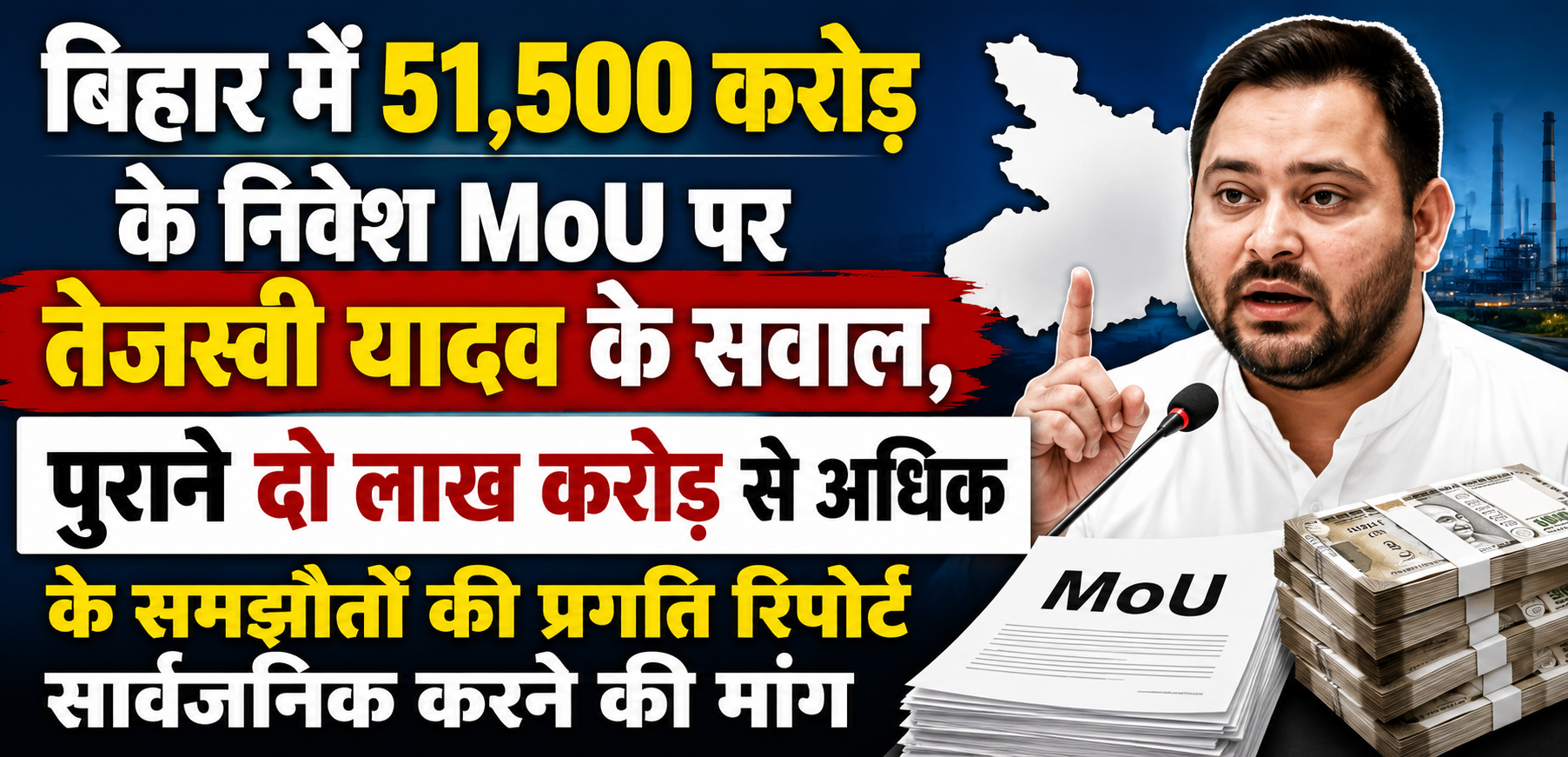
Tejashwi Yadav Questions ₹51,500 Crore Investment MoUs in Bihar, Demands Progress Report on Earlier Agreements Worth Over ₹2 Lakh Crore
Patna: The political debate over industrial investment in Bihar has intensified, with Leader of the Opposition Tejashwi Yadav questioning investment-related Memorandums of Understanding (MoUs) signed between the Bihar government's Industries Department and various industrial groups.
Tejashwi Yadav alleged that the government is widely publicising new agreements involving investments of around ₹51,500 crore, but is not making public a progress report on MoUs worth more than ₹2 lakh crore that were signed earlier.
He has demanded that the government release details about the status of these earlier agreements and clarify how many proposed projects have actually moved forward, how much investment has reached the ground and how many employment opportunities have been created.
Opposition Questions New Investment Agreements
The Bihar government has been focusing on attracting industrial investment to the state. As part of these efforts, investment-related agreements are being signed with different industrial groups.
Tejashwi Yadav has questioned the publicity surrounding the new agreements and said that the government should also provide details about the implementation of earlier MoUs.
According to the opposition's argument, the success of an investment initiative cannot be assessed merely by the amount announced in an MoU. It is equally important to determine whether the proposed projects have actually progressed.
After an MoU is signed, projects generally go through several stages, including land arrangements, government approvals, financial planning, construction and production. Therefore, information about the current status of each project is important.
Issue of Earlier MoUs Worth Over ₹2 Lakh Crore
Tejashwi Yadav has specifically raised the issue of earlier MoUs involving investments of more than ₹2 lakh crore.
He has sought a detailed progress report on these agreements, including information about how many proposals have been converted into actual industrial projects.
The opposition wants the government to clarify how many companies have started work on the ground, how many projects are currently under implementation and how many remain at the proposal or approval stage.
Information about projects where production has already started and the number of jobs generated would also provide a clearer picture of the actual impact of these investment commitments.
Difference Between an MoU and Actual Investment
It is important to distinguish between an MoU and actual investment. An MoU generally represents an understanding between the government and an industrial group to explore or pursue a proposed project.
However, signing an MoU does not necessarily mean that the entire proposed investment has already entered the state.
Projects may require land, financial arrangements, environmental approvals, regulatory clearances and other administrative procedures before construction and production can begin.
Therefore, along with announcing investment figures, providing updates on the actual implementation of projects is essential.
Employment Remains a Key Concern
One of the most important expected benefits of industrial investment in Bihar is employment generation. Large numbers of young people from the state travel to other states and cities in search of jobs.
Industrial projects can create direct and indirect employment opportunities for local residents. They can also benefit transport, construction, services, suppliers and small businesses.
For this reason, employment figures are an important part of evaluating the success of investment agreements.
If large investment figures are announced, it is also relevant to know how many jobs are expected to be created and how many have actually been generated so far.
Question of Transparency
Making investment agreements and their progress reports publicly available can improve transparency.
If a project is delayed, information about the reasons for the delay can help explain the situation. Similarly, if an investor withdraws from a proposed project, the reasons for the decision can be examined.
The government could potentially provide periodic updates covering the name of the project, proposed investment, company or industrial group involved, location, current status, actual investment and employment generation.
Challenge of Creating an Investment-Friendly Environment
Industrial development has long been an important economic and political issue in Bihar. One of the major challenges for successive governments has been attracting investors and ensuring that projects remain viable in the state.
Investment requires adequate infrastructure, including roads, electricity, land, transportation and skilled labour. Efficient and time-bound government procedures are also important for companies setting up industrial units.
Investment agreements can generate economic benefits only when projects move beyond announcements and reach the implementation stage.
Need for Monitoring Industrial Projects
Monitoring is an important part of any major investment agreement. Government departments need to track whether projects are progressing according to their proposed timelines.
If a project is delayed because of land, approvals or other administrative issues, the relevant departments need to work toward resolving those problems.
Similarly, if an investor decides not to proceed with a project, understanding the reasons can help improve the investment environment and future policy decisions.
Regular reviews can help reduce the gap between investment announcements and actual implementation.
Tejashwi Yadav Demands Answers
The central issue raised by Tejashwi Yadav is that while the government is highlighting new MoUs, it should also disclose the status of previous agreements.
The opposition wants the public to know how many of the earlier investment proposals have reached the ground, how much actual investment has taken place and how many jobs have been created.
His demand comes at a time when industrial investment and employment remain major topics of political and economic discussion in Bihar.
The government's response to these questions is therefore likely to attract attention.
Investment Announcements Must Translate Into Ground-Level Results
An industrial investment announcement becomes meaningful when its impact can be seen on the ground.
Once a project becomes operational, it can benefit construction, transportation, local businesses and service providers while creating employment opportunities.
Large industrial projects can also generate opportunities for small and medium-sized businesses by creating demand for local suppliers and services.
Therefore, the actual progress of investment projects is an important indicator of Bihar's economic development.
Public Needs Clear Data
Large investment figures often attract public attention, but citizens also need to know how much of the proposed investment has actually been implemented.
Information about the number of projects that have started, the amount invested, production status and employment generation can help people evaluate the impact of government investment policies.
Regular publication of such data could improve transparency and strengthen public confidence in industrial development initiatives.
Leader of the Opposition Tejashwi Yadav has questioned the new investment MoUs worth around ₹51,500 crore in Bihar. He alleged that while the government is publicising the new agreements, it has not released a detailed progress report on earlier MoUs involving more than ₹2 lakh crore.
He has demanded that the government clarify how many of the earlier agreements have actually been implemented, how much investment has reached the state and how many employment opportunities have been created.
An MoU can be an important first step toward an industrial project, but its real success can ultimately be measured by implementation, actual investment, production and employment generation.
Therefore, publishing progress reports on earlier agreements along with details of new investment proposals could make the debate over Bihar's industrial development more transparent and fact-based. The issue is likely to remain an important part of the state's political and economic discussion as Bihar continues its efforts to attract industrial investment and create employment opportunities.