

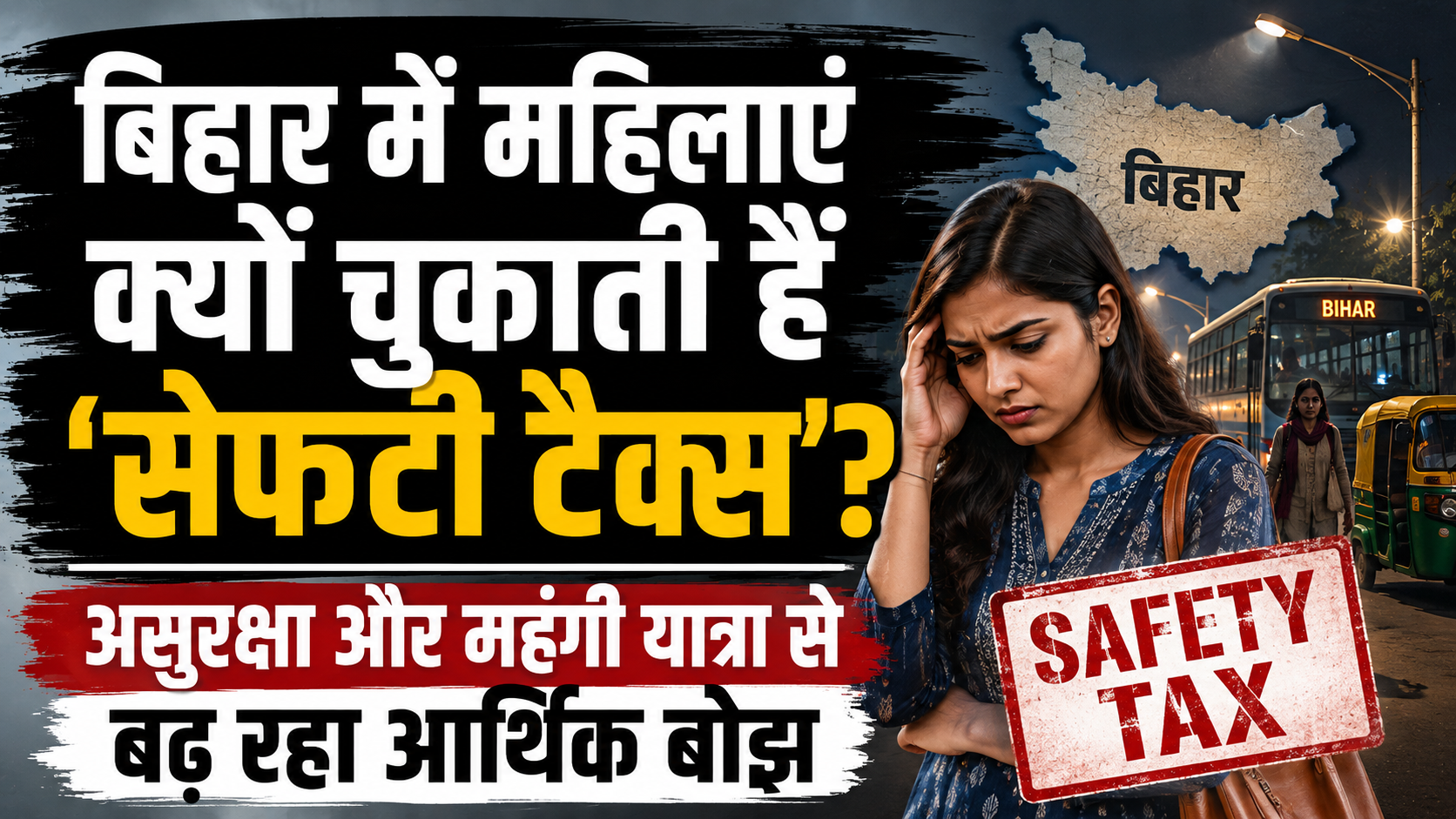
Why Are Women in Bihar Paying a ‘Safety Tax’? Insecurity and Expensive Travel Are Increasing Their Economic Burden
Women’s safety and access to public transportation have once again become important issues in Bihar. For many women, going outside the home is no longer simply a question of commuting from one place to another. Traveling safely has also become an additional economic and social challenge. Fear of insecurity, the need to avoid traveling late in the evening and the additional cost of safer transportation can affect women’s mobility and access to education, employment and other opportunities.
However, it is important to clarify the context of the ₹18,800 annual additional cost figure. This figure does not represent the average annual transport expenditure of women in Bihar. It comes from research by economist Girija Borker involving female students at the University of Delhi. The study found that female students were willing to spend around ₹18,800 more per year than male students to reach college safely. They were also willing to spend additional time using safer routes.
The research highlights the broader economic cost that insecurity can impose on women’s mobility.
Paying More for Safety
For women, one of the most important questions while traveling is often which route or mode of transportation is safest. While men may be more likely to prioritize lower fares or shorter travel times, women may sometimes prioritize safety even when it means paying more.
For example, a woman may have access to a low-cost bus or shared transport but may feel uncomfortable traveling alone in it. In such a situation, she may choose an auto-rickshaw, taxi or private vehicle instead. This increases her travel expenses.
This additional expenditure can broadly be described as a “safety tax”—money that women spend not necessarily because they want a more expensive mode of transportation, but because they feel they need it to remain safe.
The Context Behind the ₹18,800 Figure
The ₹18,800 figure is significant for understanding the economic dimension of women’s safety and transportation. However, it must be interpreted correctly.
Research involving female students at the University of Delhi found that they were willing to spend approximately ₹18,800 more per year than male students to reach college safely. The additional expenditure was connected to access to safer routes and educational opportunities.
The research also found that female students were willing to spend additional time traveling if it meant using a safer route.
Therefore, it would be incorrect to describe ₹18,800 as the actual additional annual transportation expense of all women in Bihar. Instead, the figure demonstrates the potential economic value women place on safety when making mobility decisions.
Insecurity Can Restrict Women’s Freedom
The impact of insecurity is not limited to transportation. If women avoid traveling alone after evening hours, their education, employment, training, social activities and personal independence can all be affected.
Some women may avoid events or activities that require them to return home late. Others may consider the distance between their workplace and home, as well as the availability of safe transportation, when choosing a job.
As a result, concerns about safety can influence career decisions. A woman may reject a better employment opportunity if reaching the workplace is difficult or returning home late is considered unsafe.
Expensive Transportation Becomes an Alternative
Women may sometimes have to use more expensive forms of transportation to feel secure. Taxis and auto-rickshaws can cost significantly more than buses or shared public transport, but women may choose them because they feel safer.
This means that the actual cost of mobility cannot always be measured simply by the price of a ticket. The fear of harassment or unsafe surroundings can increase the real cost of travel.
For women, safety can therefore become an invisible additional expense.
Time Restrictions Are Another Major Problem
The issue is not only financial. Time is another important factor.
Many women avoid traveling late at night and may need to return home before a certain time. This can prevent them from taking jobs, attending classes, participating in events or accepting opportunities that require late travel.
In some cases, women may have to leave work or an event early to catch the last bus or train. If public transportation is unavailable, they may have no option other than paying for a more expensive private vehicle.
In this way, insecurity can impose two kinds of costs on women—financial costs and time costs.
Impact on Education
Lack of safe transportation can also affect girls’ and young women’s educational choices.
If a college or educational institution is perceived as being difficult or unsafe to reach, families may hesitate to send female students there. The research involving University of Delhi students showed that safety concerns could influence students’ choice of educational institutions.
This highlights the importance of safe transportation for women pursuing higher education away from home.
For Bihar, where many young women travel from smaller towns and rural areas to larger cities for higher education, reliable and safe transportation can play an important role in expanding educational opportunities.
Impact on Employment Opportunities
Women’s economic independence depends heavily on access to employment. However, if transportation is expensive, unsafe or time-consuming, women may have fewer employment choices.
When selecting a job, women may consider not only the salary but also the distance from home, working hours and availability of transportation after work.
If a woman has to spend a significant portion of her salary on taxis every day simply to travel safely, the actual financial benefit of the job may become much smaller.
This can discourage women from accepting employment opportunities that would otherwise improve their economic independence.
Additional Pressure on Family Budgets
Higher transportation costs can also affect the financial condition of families.
For low-income households, the additional cost of safe transportation can become a significant burden. If a female student or working woman has to spend extra money every day to travel safely, the monthly cost can become substantial.
As a result, some families may hesitate to support women traveling long distances for education or employment.
Affordable and safe public transportation can help reduce this burden.
Free or Cheaper Transport Alone Is Not Enough
Making public transportation cheaper or free for women can certainly improve mobility, but reducing fares alone cannot completely solve the problem.
If buses are overcrowded, women fear harassment, bus stops are poorly lit or late-night services are unavailable, women may still choose taxis or other expensive options.
Therefore, women-focused transportation policies must address more than ticket prices. Safety, availability, frequency, timing and last-mile connectivity are equally important.
What Needs to Be Done in Bihar?
Several measures can be considered to improve women’s mobility in Bihar.
Major bus stands, railway stations and public transportation hubs should have adequate lighting, CCTV cameras and visible security personnel. Public transport services should also be more reliable during evening and night hours.
Women should not have to depend on expensive taxis simply because they do not feel safe using public transportation.
Complaint mechanisms should also be simple and effective. Women should be able to report harassment or safety concerns quickly and receive an immediate response.
Improving street lighting and ensuring safe access to bus stops and railway stations can also make a major difference.
Safer Cities Can Increase Women’s Participation
Women’s participation is essential for economic development. When women can safely access schools, colleges, workplaces and markets, families and the broader economy benefit.
Safe transportation can provide women with greater freedom. They can consider better colleges, explore more employment opportunities and participate in activities outside conventional daytime hours.
In contrast, insecurity can restrict women to a smaller set of educational and employment choices.
The Need to Eliminate the ‘Safety Tax’
Women should not have to pay an additional financial or time-related cost simply to feel safe while traveling.
The ₹18,800 research figure demonstrates how seriously women may value safety when making transportation decisions. However, this figure should not be presented as a Bihar-specific statistic.
To understand the situation in Bihar accurately, state-specific surveys and data are needed. Such studies could determine how much additional money women in different cities and rural areas spend because of safety concerns and how insecurity affects their education and employment decisions.
Women’s mobility is not merely a transportation or law-and-order issue. It is directly connected to education, employment, economic independence and social participation.
When a woman chooses an expensive vehicle instead of cheaper public transport because she feels unsafe, returns home early because of security concerns, rejects a job because of commuting difficulties or chooses a lower-ranked college simply because the route is safer, the consequences can extend far beyond transportation costs.
Bihar therefore needs a public transportation system that is safe, affordable, reliable and accessible. Security must be strengthened across the entire journey—from roads and bus stops to railway stations and the final destination.
The ₹18,800 figure is not a direct statistic for Bihar, but rather a research finding based on female students in Delhi. Nevertheless, it highlights an important question: Should women have to pay more than men, financially and in terms of time, simply to feel safe while traveling?
Addressing this issue will require better public transportation, safer public spaces, improved lighting, stronger security mechanisms and quick responses to complaints. A safer transportation system can ultimately help women in Bihar access better education, employment and economic opportunities.