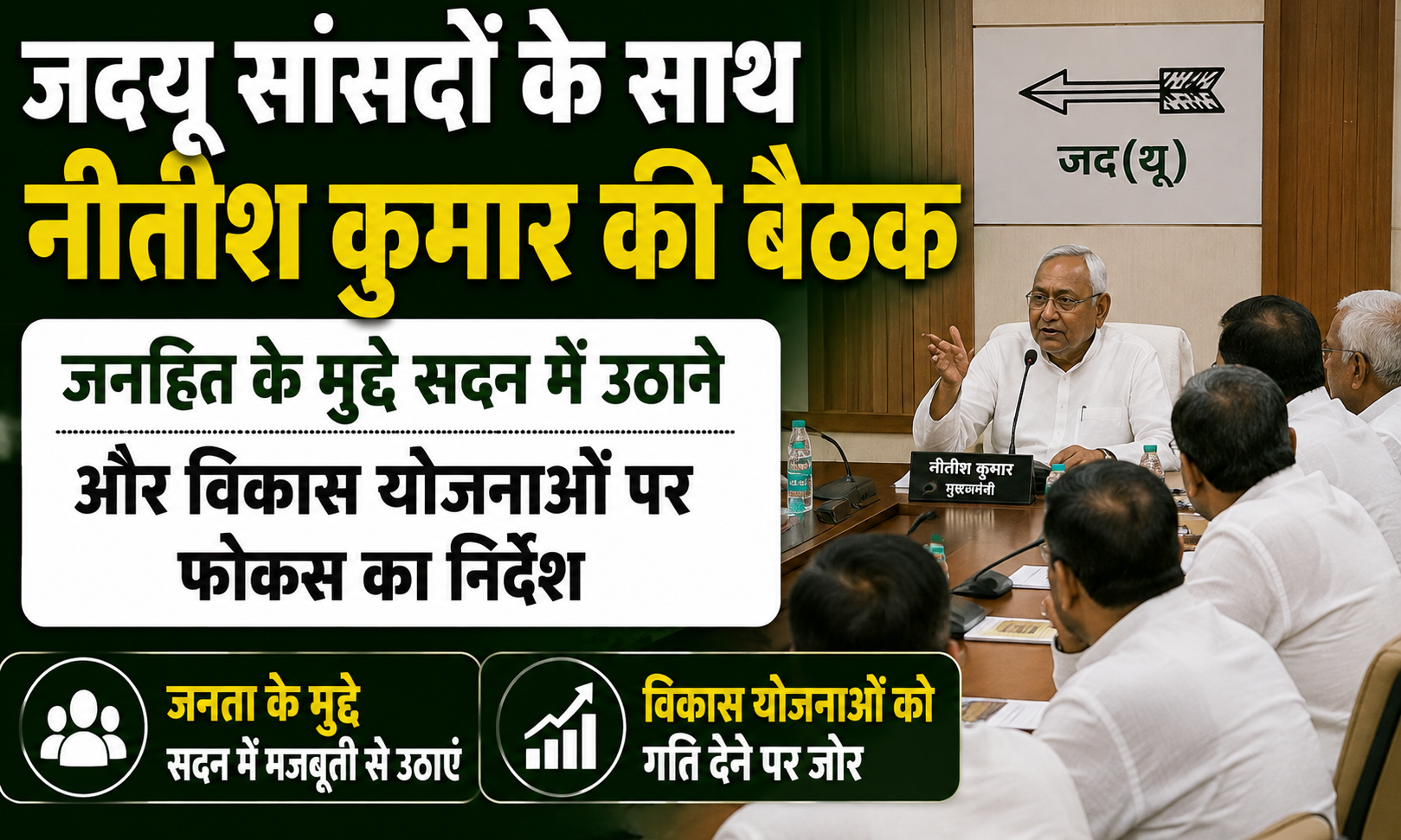
JDU President Nitish Kumar Meets Party MPs, Urges Them to Raise Public Issues in Parliament and Ensure Effective Implementation of Development Schemes
Patna: Janata Dal United (JDU) national president and former Bihar Chief Minister Nitish Kumar urged party MPs to strongly raise public-interest issues in Parliament and pay special attention to the effective implementation of development schemes in their respective constituencies.
During a meeting at Nitish Kumar's official residence, JDU MPs discussed issues concerning their parliamentary constituencies, ongoing development projects and problems faced by local residents. Nitish Kumar advised the MPs to understand the actual needs of people in their areas and play an active role in ensuring that the benefits of government schemes reach the maximum number of eligible beneficiaries.
The meeting is also being viewed as significant from a political and administrative perspective. During the interaction, Nitish Kumar emphasised the importance of development and public welfare and asked MPs to effectively raise issues concerning Bihar as well as their individual constituencies in Parliament.
Focus on Public-Interest Issues in Parliament
Nitish Kumar told the MPs that Parliament is an important platform for raising the voice of the people. MPs should therefore raise genuine issues concerning their constituencies.
Issues related to roads, railways, electricity, irrigation, education, healthcare, employment and basic infrastructure could receive greater attention.
The party leadership also expects MPs to maintain regular contact with people in their constituencies. Direct interaction with residents can help MPs understand local problems and take them up with the concerned ministries and departments.
MPs were also advised not to limit their role to Parliament but to regularly monitor development projects in their constituencies.
Emphasis on Effective Implementation of Development Schemes
Nitish Kumar placed particular emphasis on the effective implementation of development schemes. Merely announcing a scheme is not enough; its benefits must actually reach the people.
MPs were advised to coordinate with the concerned departments and local administration to monitor the progress of development projects.
Large projects can sometimes face delays because of land-related issues, administrative approvals, departmental coordination or technical problems. MPs can identify such obstacles and raise them with the appropriate authorities to help find solutions.
This could help speed up development projects and ensure that people receive promised facilities on time.
MPs Highlight Problems in Their Constituencies
During the meeting, JDU MPs reportedly presented issues from their respective parliamentary constituencies. They briefed the party leadership about ongoing development projects, pending works and demands raised by local residents.
Issues ranging from roads and transportation to railway connectivity, educational institutions, healthcare, irrigation and employment were discussed.
The need to strengthen basic infrastructure in rural areas was also highlighted.
In many constituencies, projects that have remained pending for a long time require intervention at the ministry or administrative level. MPs will therefore have an important role in coordinating with the concerned ministries and ensuring progress.
Focus on Bihar-Related Issues
JDU MPs were also expected to effectively raise broader issues concerning Bihar in Parliament.
Expansion of infrastructure, road and railway projects, industrial development, employment, education and healthcare remain important areas where Bihar requires continued support and coordination between the Centre and the state.
JDU MPs can play an important role by presenting Bihar's priorities before the Central government and seeking necessary approvals and financial assistance for important projects.
Message to Maintain Contact With the Public
Nitish Kumar also emphasised the importance of MPs remaining active among the people.
For any elected representative, understanding ground-level problems is essential. Regular interaction with residents of villages, towns and urban areas can help MPs identify problems more accurately.
Direct communication can also help determine whether government schemes are actually benefiting people. If beneficiaries face difficulties, MPs can raise those issues with the relevant departments.
MPs are expected to remain actively involved in public meetings, development programmes and local interactions.
Monitoring Central Government Schemes
Monitoring the implementation of Central government schemes was also highlighted as an important responsibility.
Various government schemes are designed to benefit farmers, women, youth, students, economically weaker sections and other groups.
MPs can help ensure that eligible people in their constituencies are aware of these schemes and do not face unnecessary difficulties while applying for or receiving benefits.
If administrative problems arise during implementation, MPs can take them up with the concerned officials.
Special Attention to Education and Employment
Education and employment remain major concerns for Bihar's youth. MPs can therefore play an important role in raising youth-related issues in Parliament.
Expansion of higher education institutions, technical education, skill development, employment opportunities and industrial investment are important for the state's future.
MPs can assess the needs of young people in their constituencies and help advance relevant government programmes.
Agriculture and Rural Development
A large section of Bihar's population depends on agriculture and the rural economy. Issues concerning farmers therefore also need attention.
Irrigation, rural roads, availability of fertilisers and seeds, fair crop prices, storage facilities and access to markets are important concerns for rural communities.
MPs can raise these issues in Parliament and seek assistance from the concerned ministries. Monitoring rural development schemes can also become an important part of their responsibilities.
Improving Healthcare Facilities
Strengthening healthcare facilities in rural and semi-urban areas is another important requirement.
Availability of doctors and healthcare workers, medicines, diagnostic facilities and better treatment services are directly connected with public welfare.
MPs can review the status of healthcare projects in their constituencies and raise demands with the Central or state government whenever additional support is required.
Political Significance of the Meeting
Nitish Kumar's meeting with JDU MPs is also considered significant from an organisational and political perspective.
Regular communication between the party leadership and MPs can help strengthen parliamentary strategy. It can also help determine which issues concerning Bihar should receive priority in Parliament.
For JDU, maintaining strong public contact through its elected representatives is also important. Better coordination between the party organisation and MPs can strengthen its connection with voters.
Ground-Level Results More Important Than Announcements
One of the key messages from the meeting was that announcing development schemes is not sufficient. The real benefit must reach people on the ground.
A project can be considered successful only when construction is completed on time, eligible beneficiaries receive government assistance and people actually get better services.
For this reason, MPs were encouraged to monitor development projects in their constituencies and coordinate with officials to resolve implementation-related problems.
MPs Will Have an Important Role Ahead
The role of JDU MPs will remain important both inside Parliament and in their respective constituencies.
Along with raising issues concerning Bihar and their constituencies in Parliament, they will also need to monitor development activities on the ground.
The meeting made it clear that the JDU leadership wants its MPs to take an active role in public welfare and development-related issues.
The challenge now will be for the MPs to effectively communicate people's problems in Parliament and actively help ensure that government schemes reach the intended beneficiaries.
Overall, JDU national president Nitish Kumar's meeting with party MPs focused on public welfare, monitoring development schemes, raising Bihar-related issues in Parliament and maintaining regular contact with the people. The concerns presented by MPs from their respective constituencies will also help the party leadership understand the situation at the grassroots level.
The effectiveness of the meeting will ultimately depend on how the MPs implement these directions in their constituencies and how strongly they raise Bihar's concerns in Parliament.