


More Than 2 Million Saplings Planted in Five Years, 30–40% Reportedly Dried Up Due to Poor Maintenance; Accurate Data Needed
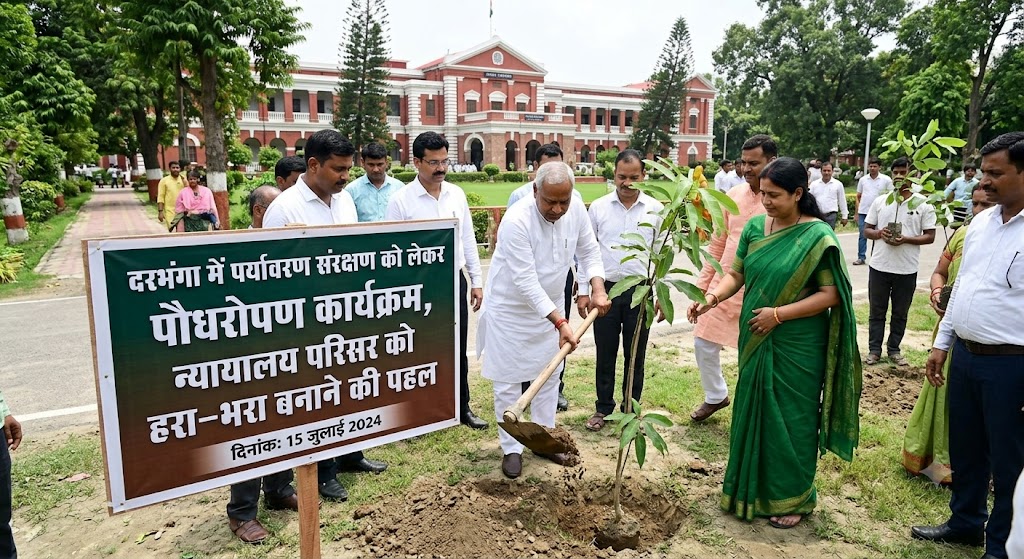
Munger: A large-scale plantation campaign has been carried out in Munger district over the past five years with the objective of increasing green cover and strengthening environmental conservation. More than 2 million saplings have reportedly been planted through various government departments, local institutions and community-level initiatives.
However, questions are now being raised about the survival and maintenance of these saplings. According to information emerging at the local level, around 30 to 40 percent of the planted saplings have dried up due to inadequate maintenance and care.
If this estimate is accurate, a significant number of saplings may have failed to survive despite the large-scale plantation drive. This makes it important to assess not just the number of saplings planted, but also how many are currently alive and developing into mature trees.
More Than 2 Million Saplings Planted in Five Years
Over the past five years, plantation drives have been conducted at various locations across Munger district. Saplings have been planted on government land, along roadsides, in public premises, educational institutions, panchayat areas and other suitable locations.
The objective has been to expand the district's green cover and maintain ecological balance. Increasing tree cover is considered particularly important amid growing urbanization, construction activity and environmental pressures.
Different varieties of fruit-bearing, shade-giving and locally suitable trees have reportedly been planted under various schemes. However, it is important to maintain a consolidated record showing the number of saplings planted, their locations and their current survival status.
Lack of Maintenance Has Become a Major Challenge
Planting a sapling is only the first step. Young plants require regular watering, protection, nutrients and monitoring during their initial years.
In Munger, concerns have reportedly emerged regarding the maintenance of saplings after plantation. During summer, lack of water, damage caused by animals and various construction activities can affect newly planted saplings.
If protective guards are not installed and regular irrigation is not provided, a significant number of young plants can dry up.
Estimate of 30–40% Sapling Loss
Information available indicates that around 30 to 40 percent of the planted saplings may have dried up. However, this figure could be based on an estimate or local assessment. A detailed survey at the departmental and site levels would be necessary to determine the actual situation.
If the figure of more than 2 million planted saplings is taken as the base, a loss of 30 to 40 percent would mean that hundreds of thousands of saplings may not have survived.
Such a situation raises questions about the effectiveness of plantation drives and the monitoring systems used after planting.
Therefore, instead of publishing only plantation figures, authorities should also make the survival rate of planted saplings a key performance indicator.
Need for Accurate Data
Transparent data is extremely important for environmental conservation programs.
Information should be maintained on how many saplings were planted in Munger over the last five years, how many remain alive, how many have dried up and how many have successfully developed into trees.
For this purpose, records could be prepared for every plantation site. These records could include the date of plantation, number of saplings, species, location, responsible department or organization and present condition.
Such a system would make it easier to evaluate the actual success of plantation campaigns in the future.
Conservation More Important Than Plantation Alone
Plantation drives cannot increase green cover simply by increasing the number of saplings planted. Real success comes when saplings survive for several years and eventually grow into mature trees.
The same level of attention required to plant a sapling must also be given to its maintenance.
If a sapling dries up within a few months of being planted, the primary objective of the plantation campaign is not achieved.
Therefore, future campaigns should clearly assign responsibility for protecting and maintaining saplings for at least their initial years of growth.
Impact of Heat and Water Shortages
Like many parts of Bihar, Munger experiences periods of high temperatures during summer. Water availability can become a major challenge for young plants during such conditions.
Even if plantation is carried out during the rainy season, saplings can dry up in subsequent months if regular irrigation is not available.
Authorities should therefore develop proper watering and irrigation plans for plantation sites. Panchayats, local bodies and concerned departments can coordinate to ensure that saplings receive adequate care.
Protection From Animals Also Necessary
Saplings planted in rural and open areas can also be damaged by livestock.
In many cases, the absence of protective fencing or tree guards can result in young plants being eaten or destroyed by animals.
Protective structures can be installed around newly planted saplings. Community participation can also be encouraged to monitor plantation sites.
If local groups are given responsibility for protecting saplings in villages or panchayats, their chances of survival could improve.
Additional Precautions Needed for Roadside Plantation
Saplings planted along roads face several challenges. Road widening, drainage construction, electricity and telecommunications work and other development activities can damage plants.
Coordination between road development projects and plantation programs is therefore essential.
Whenever road construction or widening is planned, authorities should maintain records of trees and saplings already planted in the affected areas.
Role of Schools and Community Institutions
Schools, colleges and community organizations can play an important role in protecting saplings.
If trees are planted within school premises, students and teachers can participate in their maintenance. This can also help develop environmental awareness among children.
Similarly, local committees can be formed at the panchayat level to monitor plantation sites.
Monitoring Survival Rates
In future plantation campaigns, the survival rate of saplings could be used as a key measure of success.
For example, if 1,000 saplings are planted at a particular location, authorities can record how many remain alive after one year, three years and five years.
This would help identify which tree species and locations are most suitable for plantation.
Priority to Native Species
Selecting species that are naturally suited to the local climate and soil can improve the chances of survival.
Locally suitable trees generally require less intensive maintenance and may adapt better to regional environmental conditions.
Before plantation, authorities could assess soil conditions, water availability and other characteristics of the proposed location.
Digital Monitoring Can Improve Transparency
Technology can be used to improve monitoring of plantation programs.
Details such as photographs, locations and the number of saplings planted at each site can be recorded digitally.
Photographs can be taken periodically from the same locations to compare the condition of saplings over time.
Such a system could help reduce the possibility of inaccurate reporting and make plantation data more transparent.
Public Participation Is Essential
Government efforts alone may not be sufficient. Public participation is also important for protecting newly planted trees.
If local residents consider the saplings around their communities as a shared responsibility, their chances of survival can increase.
Community-based maintenance systems can be developed in villages, neighborhoods and public spaces.
Local youth and voluntary organizations can also be involved in environmental campaigns.
Actual Objective of Plantation Campaigns
The purpose of plantation is not merely to increase the number of saplings planted. The long-term objective is to expand green cover and create a healthier environment.
Mature trees contribute to better air quality, temperature regulation, soil conservation and biodiversity.
Therefore, protecting saplings until they become established trees should be considered the real measure of a successful plantation campaign.
Need to Focus on Future Strategy
A survey of the saplings already planted in Munger would help determine their current condition.
Such a survey could identify areas where maintenance has been inadequate and locations where survival rates have been comparatively better.
Where large numbers of saplings have dried up, replantation can be considered where necessary.
Future plantation programs should also include dedicated maintenance budgets and clearly defined responsibilities for officials or organizations.
Planting more than 2 million saplings in Munger over the past five years represents a significant environmental initiative. However, if 30 to 40 percent of these saplings have dried up due to inadequate protection and maintenance, the situation requires attention.
The actual figures should be verified through departmental, location-wise and year-wise assessments. A clear record of how many saplings were planted and how many are still alive would allow authorities and the public to evaluate the real success of the plantation campaign.
The priority now should not be limited to planting more saplings but also protecting those that have already been planted.
Regular watering, protective fencing, local monitoring, digital records and community participation can improve survival rates.
If plantation programs are implemented as long-term conservation initiatives rather than simply as numerical targets, Munger can achieve meaningful growth in green cover in the coming years. This would provide lasting environmental benefits for the district and future generations.