

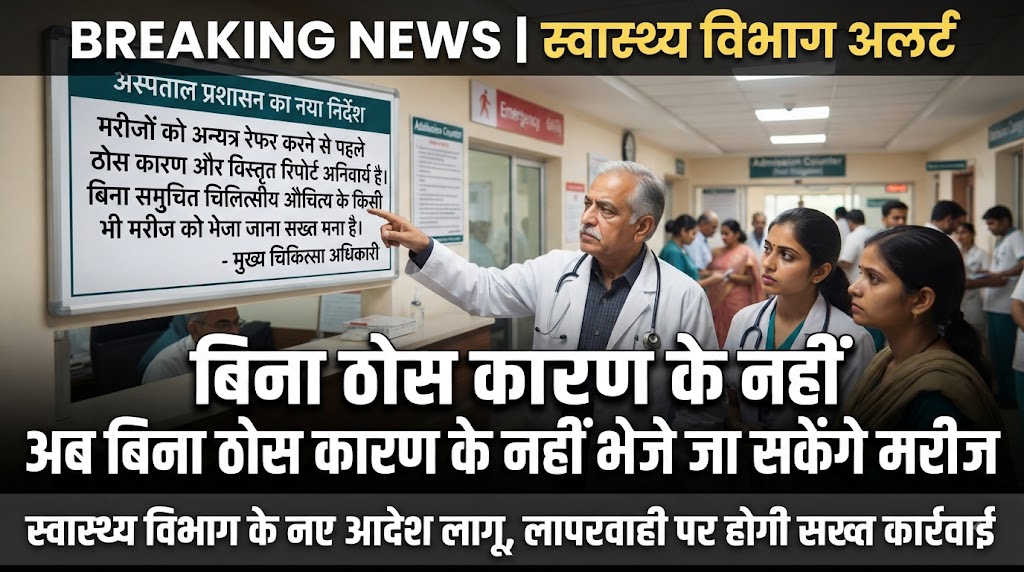
New Directives Issued to Make the Patient Referral System Transparent and Smooth; Patients Can No Longer Be Referred Without Concrete Reasons
Patna/Bhagalpur: To further strengthen, render transparent, and make accountable the healthcare system of Bihar towards patients, the state government and the health department have taken a highly significant and stringent step. Frequently, it was observed that patients visiting Primary Health Centres (PHCs) and Community Health Centres (CHCs) were referred to larger hospitals (such as medical colleges or sadar hospitals) without solid justification, even after minor illnesses or routine primary treatment. This unnecessarily increased the burden on high-level medical institutions and subjected patients to severe mental and financial distress. To curb this grave issue, the health department has issued new and detailed guidelines to completely overhaul the patient referral system.
What Is the Main Objective and Background of the New Directive?
The primary objective of these new provisions issued by the health department is to ensure that every citizen of the state receives quality medical treatment right at their nearest health centre, and that referrals occur solely when genuinely imperative:
Alleviating Burden: Reducing the excessive patient load mounting on PMCH, NMCH, JLNMCH (Bhagalpur), and other medical colleges.
Ensuring Transparency: Establishing clear and standard treatment guidelines regarding the exact circumstances under which a patient must be referred, preventing doctors from arbitrarily dismissing patients.
Establishing Accountability: Making it mandatory to record the attending doctor's name, the reason for referral, and the complete clinical status for every transfer so that negligent parties can be penalized.
Key Highlights and Provisions of the New Guidelines
According to the health department's fresh order, strict adherence to the following rules has now been made mandatory across hospitals:
Mandatory Disclosure of Reasons: No physician will now be permitted to verbally or arbitrarily refer a patient to a larger hospital without a solid clinical justification. The prescription must explicitly state the specific reason or advanced treatment requirement necessitating the transfer.
Ambulance and Coordination Services (102 / 108): The new directive also ensures that whenever a patient is clinically referred to a higher institution, an ambulance service (102) must be immediately provided, and coordination with the emergency ward of the receiving hospital must be established beforehand via phone or portal to initiate treatment the moment the patient arrives.
Adherence to the Golden Hour: Emphasizing the significance of the "Golden Hour" in road accidents or critical emergency cases (Trauma & Emergency) to preserve life, instructions have been given for swift decision-making, ensuring patients' lives are saved without wasting time on paperwork.
Review Meetings and Monitoring: At the district level, Civil Surgeons and senior health department officials will review on a monthly basis how many patients were referred from each hospital and in how many instances a larger facility was genuinely required. Explanations will be sought from doctors and institutions making unnecessary referrals.
Relief for the General Public and Patients
Poor and helpless patients hailing from remote rural pockets are expected to benefit the most from this new directive:
Freedom from Unnecessary Running Around: Often, impoverished patients fell prey to ambulance fares and private hospital exploitation because they were referred to major cities even for minor ailments. The introduction of these new rules will check this illicit tendency.
Savings of Time and Money: Patients' confidence in receiving better treatment at their local health centres will grow, sparing them from unnecessary travel and financial ruin.
This step taken by the health department holds the potential to revolutionize healthcare services in Bihar. Going beyond paper claims, if this new referral directive is implemented on the ground with absolute strictness and integrity, it will not only reinforce public trust in government hospitals but also ensure timely and appropriate treatment for critical patients. It will now be crucial to observe how earnestly district-level hospitals and practitioners comply with this new directive.